
Hardware: Facilities Triage
Every building deserves a BAS
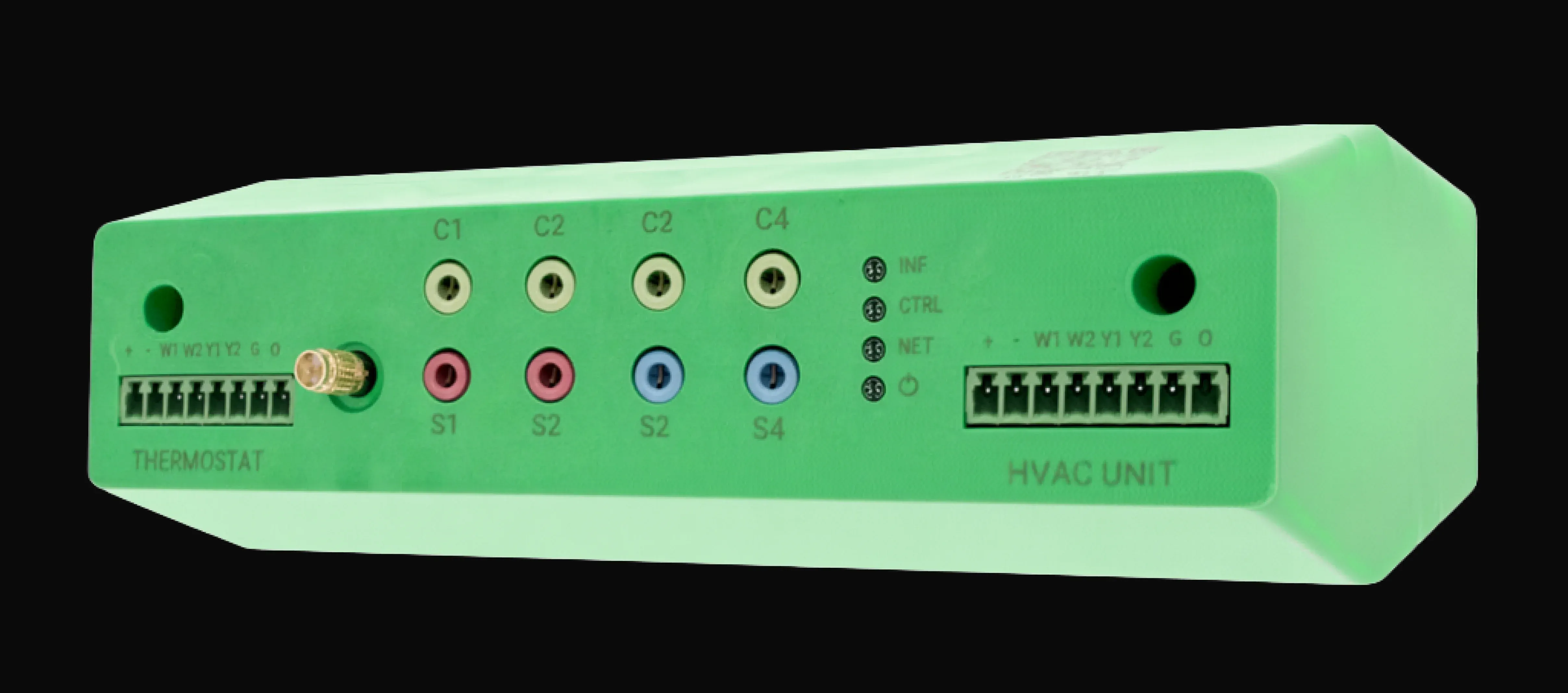
Every unit in your portfolio is generating data right now — temperatures, compressor load, refrigerant pressure, acoustic signals that precede failure. That data sits unread until something breaks. The RAC changes that. It installs in-line between your existing thermostat and HVAC equipment, draws from the 24VAC supply already on your rooftop unit, and connects to FTL Cloud via built-in cellular. No separate power supply. No network configuration. No IT approval. Any HVAC technician can complete the install in under an hour. From that moment, your building can be put to work.
// FTL Hardware
Explore our Hardware
Affordable asset monitoring & control
I/O at a glance
Input | Quantity | What it monitors |
|---|---|---|
Voltage terminal block | 16 | Voltage monitoring and control outputs |
1-wire inputs 3.5mm TRS | 4 | Digital sensor inputs |
Analog inputs 3.5mm TRS | 4 | Current monitoring |
Onboard acoustic microphone | 1 | Mechanical fault detection via sound anomaly |
Onboard temperature sensor | 1 | Board ambient temperature |
Connectivity
Interface | Type | Purpose |
|---|---|---|
Power | 24V AC or DC | Draws from existing asset control power supply, or from DC converter |
Cellular | Built-in | Primary uplink - live from moment of installation |
SPE Single-Pair Ethernet) | Built-in | Backup connectivity for rural locations or when local networking is required |
LoRa | Long-range wireless | Connects data from remote LoRa sensors and communicates with Terminal |
The worlds first completely wireless smart thermostat
Function | Description |
|---|---|
Zone Comfort Control | Setpoint and schedule control, including monitoring of zone temperature, humidity and pressure. |
Occupant Service Requests | Occupants can enter service requests using the Stat, which are automatically logged and routed to the facility manager for triage. Diagnostic data is captured with each service request and included with subsequent work orders. |
Status Updates | Stat display indicates the operating mode with icons for heating, cooling, and fan operation. Equipment status and the status of open work orders are displayed, including technician updates for active work orders. |
Device features
Feature | Specification |
|---|---|
Power | Solar + Replaceable AA batteries—no wiring, no transformer connection required. Solar panel provides 2+ years between battery replacements |
Display | 5.83” e-paper—920680 resolution, 0.75s full refresh, 0.3s partial refresh |
Sensors | Temperature, relative humidity |
Input | Touchscreen + side buttons |
Visual Alerts | RGB LED status bar—equipment status and notification indicators, visible across the room |
Connectivity | Wireless via LoRa to RAC or Terminal |
Field Server with multi-zone control
Function | Description |
|---|---|
Onsite Display | Total site visibility for supported building systems, such as HVAC, including zone controls, asset performance data, alerts and work order management |
Asset Monitoring | Connects to RACs, REMs, Senstick and 3rd patry LoRa sensors for asset performance monitoring, including power and sensors (e.g., temperature, pressure, etc.) |
Asset/Zone Control | Enables onsite control of all assets, even without Internet connectivity |
Interoperability with Existing BAS | Enables data integration from existing BAS (e.g., JACE to FTL Terminal via oBIX |
Gateway to FTL Cloud | Connects to FTL Cloud via Ethernet, cellular or Starlink (optional) |
Device features
Feature | Specification |
|---|---|
Display | 13.1” LCD capacitive touchscreen |
Power | Power over Ethernet PoE; PoE adapter included |
Cloud Connectivity | Ethernet, cellular or Starlink (optional) |
FTL Gateway (optional) | Rooftop gateway for multi-unit sites—whole-building LoRa coverage, outdoor-rated IP67, Ethernet backhaul with optional cellular or Starlink |
Wireless Network | Built-in LoRaWAN— connects directly to RAC, REM, Stat, Senstick, and 3rd -party devices |
BAS integration | Dedicated Ethernet port—connects to a traditional JACE via oBIX, pulling existing BAS data into the FTL Cloud |
Self-powered equipment monitoring
I/O at a glance
Input | Quantity | What it monitors |
|---|---|---|
1-wire sensors 3.5mm TRS | 4 | Supply, return, and auxiliary temperatures |
Current clamp inputs 3.5mm TRS | 4 | Compressor and fan motor load |
Onboard acoustic microphone | 1 | Mechanical fault detection via sound anomaly |
Connectivity
Interface | Type | Purpose |
|---|---|---|
Power | Self-powered from current clamps | Continuous monitoring without wiring or batteries |
LoRaWAN | Long-range wireless | Communicates live data to Terminal or LoRa Gateway |
// FAQ
Got questions?
We have answers.
The RAC monitors supply and return temperatures, compressor and fan motor current draw, refrigerant high and low side pressure, and uses an onboard acoustic microphone to detect sound anomalies that can indicate mechanical faults developing before they become failures. It also monitors board ambient temperature and collects data from Senstick wireless sensors across wider areas via LoRa.
If your buildings already have controls infrastructure, the Terminal integrates that data directly into FTL Cloud without replacing what's there. FTL reads what your system already generates and brings it into the same intelligence layer as buildings connected via RAC. The investment you've already made stays in place.
Yes. Built-in cellular is the primary uplink, drawing power from the existing 24VAC supply on the unit. Satellite connectivity is also available for remote or off-grid locations where cellular coverage is limited or unavailable.
One RAC per HVAC unit. For buildings with multiple rooftop units, a RAC installs on each one. Where a multi-zone or multi-unit configuration is in use, the Terminal acts as the site communications hub, aggregating data across the building and relaying it to the platform.
At launch, the RAC's primary coverage is HVAC. The REM extends monitoring to small refrigeration units and mini-splits. Additional verticals are covered through a phased expansion of FTL devices and third-party sensor integrations via the Terminal.

// Newsletter
Stay in the Loop.
Not ready for a chat just yet? We get it. In the meantime, join the FTL mailing list for platform updates, program news, and industry context as we see it.

// Contact
Talk to Dave.
Dave is FTL's Head of Sales. Have a direct conversation about whether FTL is right for you and what that could look like in practice.